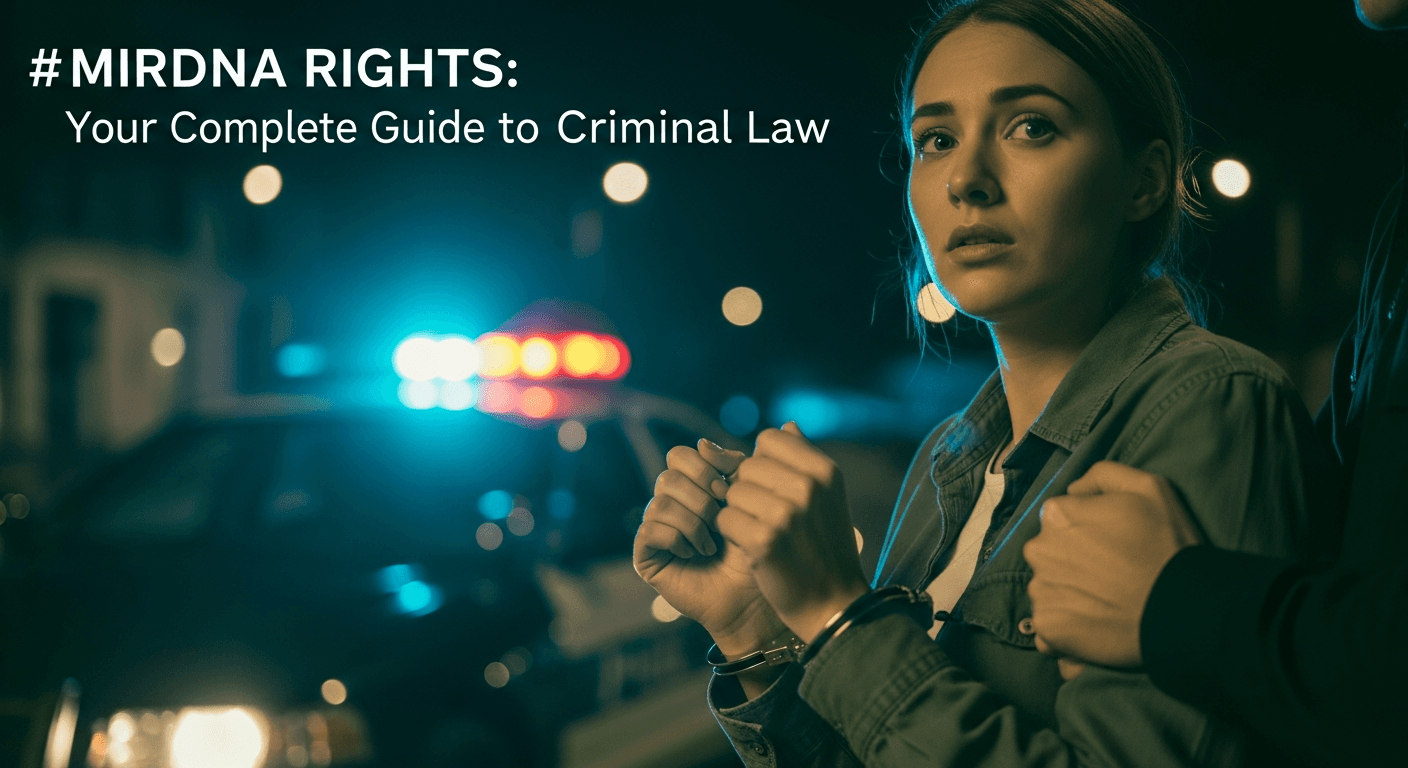
Miranda Rights: Your Complete Guide to Criminal Law
Understanding your *Miranda Rights* is crucial if you've been arrested. This guide breaks down the essentials of criminal law and your legal rights, ensuring you know what to do when facing law enforcement.
Miranda Rights: Your Complete Guide to Criminal Law Basics
Imagine being pulled over, questioned, and suddenly placed under arrest. Do you know your rights? Understanding your Miranda Rights is essential to protect yourself within the criminal justice system.
Introduction
The Miranda Rights are a cornerstone of the American legal system, designed to protect individuals from self-incrimination during police questioning. This guide provides a comprehensive overview of these rights, explaining when they apply, what they mean, and how to exercise them effectively. Whether you're facing legal trouble or simply want to be informed, this information is crucial. We'll cover everything from the basics of criminal law to practical scenarios, ensuring you’re prepared for any interaction with law enforcement.
What You'll Learn in This Guide
- What are Miranda Rights?
- When Do Miranda Rights Apply?
- The Importance of Remaining Silent
- Waiving Your Miranda Rights
- What Happens If Miranda Rights Are Violated?
- Seeking Legal Counsel
What are Miranda Rights?
The Miranda Rights, stemming from the landmark Supreme Court case Miranda v. Arizona (1966), are a set of rights that law enforcement officers must inform a suspect of before custodial interrogation. These rights are designed to protect the Fifth Amendment right against self-incrimination and the Sixth Amendment right to an attorney.
Specifically, the Miranda warning includes the following:
- You have the right to remain silent.
- Anything you say can be used against you in a court of law.
- You have the right to an attorney.
- If you cannot afford an attorney, one will be appointed for you.
These warnings ensure that individuals understand their rights and can make informed decisions about speaking to the police. Failure to provide these warnings can result in any statements made during interrogation being inadmissible in court.
The Fifth Amendment
The Fifth Amendment to the United States Constitution protects individuals from being compelled to incriminate themselves. This means you cannot be forced to provide testimony or evidence that could lead to your own conviction.
- The Fifth Amendment is a fundamental right.
- It applies to all individuals, regardless of their guilt or innocence.
- It is designed to prevent coercive interrogation tactics.
The Sixth Amendment
The Sixth Amendment guarantees the right to an attorney. This means you have the right to have legal counsel present during questioning. If you cannot afford an attorney, the court will appoint one to represent you.
- The Sixth Amendment ensures a fair trial.
- It provides access to legal representation.
- It is essential for protecting your rights throughout the criminal law process.
When Do Miranda Rights Apply?
Miranda Rights are not required in every interaction with law enforcement. They are specifically triggered when two conditions are met: custody and interrogation. Understanding these conditions is vital for knowing when your rights are in effect.
Custody
Custody refers to being deprived of your freedom of movement to a degree associated with a formal arrest. This doesn't necessarily mean you are physically in jail. It means a reasonable person would not feel free to leave.
- Custody implies a significant restriction on your freedom.
- Traffic stops are generally not considered custodial unless they escalate.
- Being detained in a police car can be considered custody.
Interrogation
Interrogation refers to questioning initiated by law enforcement that is designed to elicit incriminating responses. This includes direct questioning and any actions or statements by officers that are reasonably likely to prompt a suspect to incriminate themselves.
- Interrogation involves direct questioning or its equivalent.
- Voluntary statements are not considered interrogation.
- Routine booking questions are generally not considered interrogation.
Situations Where Miranda Rights Are Not Required
There are specific situations where Miranda Rights are not required, even if you are speaking with law enforcement.
- Voluntary Statements: If you volunteer information without being asked, it can be used against you.
- Routine Booking Questions: Questions about your name, address, and date of birth during booking are exempt.
- Public Safety Exception: If there is an immediate threat to public safety, officers can ask questions without reading your Miranda Rights.
The Importance of Remaining Silent
One of the most critical aspects of Miranda Rights is the right to remain silent. This right protects you from inadvertently incriminating yourself. It's often the best course of action to exercise this right until you have spoken with an attorney.
Why Silence is Golden
Speaking to the police without legal representation can be risky. Even seemingly innocent statements can be twisted or used out of context to build a case against you.
- Police are trained to elicit information.
- Anything you say can be used against you.
- Remaining silent protects you from unintentional self-incrimination.
How to Assert Your Right to Remain Silent
To effectively assert your right to remain silent, you must clearly and unequivocally state that you wish to remain silent. Simply remaining silent is not enough. You must verbally express your intention.
- Clearly state, "I am invoking my right to remain silent."
- Do not answer any further questions.
- Request to speak with an attorney.
The Role of an Attorney
An attorney can advise you on the best course of action and ensure your rights are protected. They can also negotiate with law enforcement on your behalf.
- An attorney can provide legal guidance.
- They can protect your rights during questioning.
- They can represent you in court.
Waiving Your Miranda Rights
Waiving your Miranda Rights means giving up your right to remain silent and your right to an attorney. This waiver must be made knowingly, intelligently, and voluntarily. It's crucial to understand the implications before making this decision.
What Does It Mean to Waive Your Rights?
When you waive your Miranda Rights, you are agreeing to speak to law enforcement without the presence of an attorney. This means anything you say can be used against you in court.
- You are giving up your right to remain silent.
- You are giving up your right to an attorney during questioning.
- Your statements can be used as evidence against you.
Requirements for a Valid Waiver
A valid waiver of Miranda Rights must meet specific requirements:
- Knowing: You must understand the rights you are waiving.
- Intelligent: You must understand the consequences of waiving your rights.
- Voluntary: The waiver must be free from coercion or duress.
Express vs. Implied Waiver
A waiver can be either express or implied:
- Express Waiver: This involves explicitly stating that you are waiving your rights.
- Implied Waiver: This can occur through your actions and words, indicating you understand your rights and are willing to speak to the police. Courts often scrutinize implied waivers more closely.
What Happens If Miranda Rights Are Violated?
If law enforcement fails to properly administer your Miranda Rights, or violates them during an interrogation, there can be significant consequences for the prosecution's case.
Suppression of Evidence
The primary remedy for a Miranda Rights violation is the suppression of evidence. This means any statements or evidence obtained as a result of the violation cannot be used against you in court.
- Illegally obtained evidence is excluded from trial.
- The prosecution cannot use the suppressed evidence to prove your guilt.
- This can lead to a dismissal of charges or a reduced sentence.
The Fruit of the Poisonous Tree Doctrine
This legal doctrine extends the exclusionary rule to evidence derived from illegally obtained evidence. If the initial violation of Miranda Rights leads to the discovery of additional evidence, that evidence may also be suppressed.
- Evidence derived from the initial violation is also inadmissible.
- This prevents the prosecution from benefiting from their unlawful actions.
- It ensures that law enforcement follows proper procedures.
Challenging Miranda Violations
If you believe your Miranda Rights were violated, it's crucial to consult with an attorney. They can file a motion to suppress the evidence and argue that it should be excluded from trial.
- Consult with a criminal defense attorney.
- File a motion to suppress the evidence.
- Present evidence of the Miranda Rights violation to the court.
Seeking Legal Counsel
Navigating the criminal law system can be complex and intimidating. Seeking legal counsel is essential to protect your rights and ensure you receive a fair trial. A criminal defense attorney can provide invaluable assistance throughout the legal process.
Benefits of Hiring an Attorney
Hiring an attorney offers numerous benefits:
- Legal Expertise: Attorneys have a deep understanding of the law and can provide expert guidance.
- Protection of Rights: They can ensure your rights are protected throughout the legal process.
- Negotiation Skills: Attorneys can negotiate with prosecutors on your behalf.
- Court Representation: They can represent you in court and advocate for your best interests.
Finding the Right Attorney
Finding the right attorney is crucial. Consider the following factors:
- Experience: Look for an attorney with experience in criminal law.
- Reputation: Check their reputation and reviews from previous clients.
- Communication: Choose an attorney who communicates clearly and effectively.
The Role of AI Legal Assistants
While an attorney provides comprehensive legal representation, AI legal assistants can offer preliminary guidance and information. For example, an AI legal assistant can help you understand the basics of Miranda Rights and what to expect during an arrest. For more in-depth assistance, consider consulting with an attorney. Myvirtualawyer offers an AI legal assistant to help with initial legal questions.
Frequently Asked Questions
What happens if the police don't read me my Miranda Rights?
If the police fail to read you your Miranda Rights before a custodial interrogation, any statements you make during that interrogation may be inadmissible in court. This means the prosecution cannot use those statements as evidence against you.
Can I invoke my right to remain silent at any time?
Yes, you can invoke your right to remain silent at any time during questioning, even if you initially waived your Miranda Rights. Once you invoke this right, the police must cease questioning you.
Do Miranda Rights apply if I'm not a U.S. citizen?
Yes, Miranda Rights apply to everyone in the United States, regardless of citizenship status. This includes undocumented immigrants and visitors.
What is the public safety exception to Miranda Rights?
The public safety exception allows law enforcement to ask questions without reading Miranda Rights if there is an immediate threat to public safety. For example, if the police are searching for a missing weapon, they can ask questions about its location without reading Miranda Rights first.
How can an attorney help me if my Miranda Rights were violated?
An attorney can file a motion to suppress any statements or evidence obtained as a result of a Miranda Rights violation. They can also investigate the circumstances of your arrest and interrogation to determine if your rights were violated and build a strong defense on your behalf.
Conclusion
Understanding your Miranda Rights is crucial for protecting yourself in the criminal law system. Remember, you have the right to remain silent and the right to an attorney. If you are arrested, exercise these rights and seek legal counsel as soon as possible. Knowing your legal rights can make all the difference. By understanding when Miranda Rights apply, the importance of remaining silent, and what to do if your rights are violated, you can better navigate interactions with law enforcement. For more information and assistance, explore the resources available through Myvirtualawyer and consult with a criminal defense attorney.

Found this article helpful? Share it!
Related Articles

Droit Pénal: Understanding French Criminal Law Basics
Navigating the French legal system can be daunting, especially when dealing with criminal law, or *droit pénal*. This guide breaks down the fundamental aspects of *droit pénal*, providing clarity on infractions, procedures, and potential penalties.
Small Claims Court: Everything You Need to Know
Navigating the legal system can feel overwhelming, especially when dealing with smaller disputes. This guide breaks down everything you need to know about **small claims court**, from understanding the **small claims limit** to **filing a lawsuit** effectively.